PUFAnalytics
Evaluate PUFs in your browser. Quality metrics with confidence intervals, identification error rates, NIST tests, attack curves and key-generation sizing.
Opens in a new tab on koustav.isroot.in.
What it does
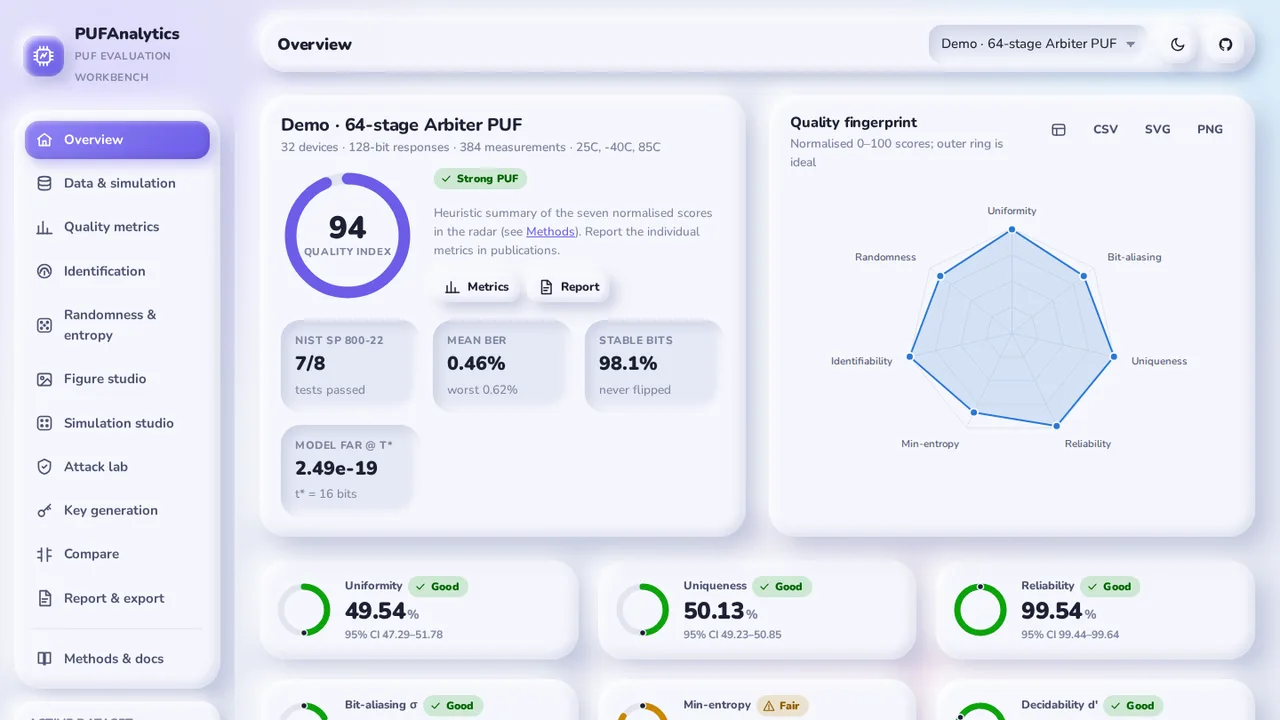
PUFAnalytics turns raw PUF read-outs into the numbers a hardware-security paper needs:
- Quality metrics. Uniformity, bit-aliasing, uniqueness, reliability, steadiness and per-condition bit error rate, each with a bootstrap confidence interval.
- Identification. Decidability, equal error rate, and false-acceptance and false-rejection rates extrapolated far below what the sample can show.
- Randomness. Eight NIST SP 800-22 tests and SP 800-90B entropy estimates.
- Attacks and keys. Machine-learning attack curves, and sizing for the error correction a key needs.
It also simulates seven kinds of PUF, runs Monte-Carlo sweeps, and draws 18 publication figures. You leave with a LaTeX table, a Markdown report, a methods paragraph and a Python script that reproduces every number.
Everything runs in your browser. Your data is never uploaded, and the app works offline.
How to use it
- Load data. Press Explore a demo population, simulate a PUF under Data & simulation, or drop in a CSV, TXT, JSON or NumPy file of your own measurements.
- Read the overview. It shows a quality index, gauges for each headline metric, and the distance distributions.
- Work down the sidebar. Go through Quality metrics, Identification, Randomness & entropy, Attack lab and Key generation in order. Each view links to its own method notes.
- Export. Report & export gives you the tables, figures, JSON and a reproduction script. Figure studio downloads every figure as SVG, PNG and CSV in one zip.
How it works
The web app’s analysis engine is a line-by-line port of the PUFAnalytics Python package. It runs in a Web Worker so the page stays responsive. Both versions draw random numbers from the same portable generator (xoshiro128**), so a population simulated with a given seed is identical in the browser and in Python. A parity test of more than 2,400 checks enforces this on every change. The blog post walks through every view and lists the full Python API.